
“We are a culture that worships the winning result: the league championship, the high test score. Coaches are paid to win, teachers are valued for getting students into the best colleges. Less glamorous gains made along the way—learning, wisdom, growth, confidence, dealing with failure—aren’t given the same respect,” William Zinsser observes in his indispensable writing guide Writing Well.
Nearly half a century later and we’re still pathologically obsessed with outcomes. We’re fixated on achievement and attainment, job titles and promotions, standardized test scores and report cards. We care about the triumphant moment of crossing the finish line—not the hours of training behind closed doors.
Yet joy is confined to the present progressive tense, in the doing, not the being done. The climber is most satisfied not when he’s reached the staggering summit of Mt. Kilimanjaro but in the struggle to get to the top. Satisfaction is the struggle.
Bliss is in the blossoming, the becoming, the process, not the product.
In his insightful, introspective memoir Something in the Woods Loves You, poet Jarod Anderson uses morel mushrooms as a metaphor for delighting in the process, not just striving toward an end result. Meditating on the subterranean magic of mushrooms and forests, he writes:
“Mushrooms are the temporary reproductive structures of massive, seldom seen, subterranean creatures more closely related to you than to plants. Fungi. Some are miles wide. Some lie thousands of years. Some help trees speak to one another. There’s magic beneath the forests.
My mom always called the woods her “church.”
I’m not sure I understood what she meant when I was small, but I reckon I understand it now.
The woods is a place where we feel the grand mysteries and tease out the spiderweb strands that connect us to them and, ultimately, us to ourselves.
It’s a place where the sheer beauty of our surroundings kindles a kind of broad attitude for being awake and aware among such a feast for the senses, such a bounty of incalculable wonders that all share a family resemblance to each other and to us.
Truthfully, I never felt actual churches felt like church, not in the way I knew they were supposed to feel from cultural osmosis, not even when I visited ancient cathedrals in Italy or the famous Abbey where Darwin is buried in London.
No painted ceiling can compare to the actual sky.”
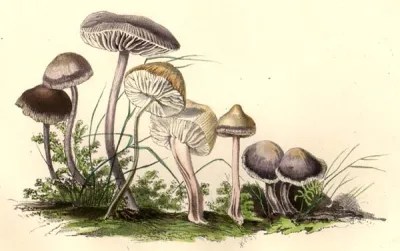
During Anderson’s idyllic Ohio childhood, nature was his church, the woods, his cathedral. His favorite quasi-religious ritual? Hunting morels. A wild mushroom found in the woodlands of the northern hemisphere, morels are prized among gourmet chefs for their rich, nutty flavor. Their strange, otherworldly caps make them look like an aquatic, almost alien creature. When the gray skies and freezing temperatures of the notoriously harsh Ohio winters gave way to the mayapples and bumblebees of early spring, Anderson and his mother knew it was time to go mushroom hunting. Sometimes they’d return with bags of the rare delicacy; other times, they’d return with nothing.
But that didn’t mean the afternoon was a waste. Even if they came back empty-handed, they had spent a few glorious hours in a wooded wonderland and witnessed many marvels of the landscape: a blue heron, majestically poised on a lake, a prehistoric creature who once shared the earth with giant ground sloths and saber-toothed tigers; a sturdy shagbark hickory tree; gray squirrels playfully darting through leaves and twigs.
Rather than cling to a certain outcome (“I must find some morels”), Anderson learns to take pleasure in the process (“I might not have found any mushrooms, but at least I experienced the startling beauty of an Ohio spring forest”).
In a beautifully buoyant passage, he writes:
“But the trick of it is that even looking and failing to find anything meant a handful of hours carefully noticing the details of a spring woodland.
No morels, but there is a well-fed toad in that bed of moss.
No morels, but here is a perfect sparrow skull as light as sculpted mist cradled on a leaf.
No morels, but here is a freshly sprouted Jack-in-the-pulpit, and don’t I remember an old story about how its dried and powdered leaves could paralyze minnows in a pool?
If the hunt for morels was a holy season in the wilderness church of my childhood memories, then the sacred rites of that festival had little to do with finding and everything to do with searching.”
Something in the Woods Loves You tells the story of a different kind of hunt—Anderson’s hunt to regain his mental health. After months of suffocating in the gray clouds of depression, Anderson finally decides to seek help. His first decision? To take anti-depressants. The medication is an enormous relief: like finding a life raft in a storm-tossed stretch of sea. It doesn’t return him to shore but at least it spares him from drowning. Medicine, he observes, “meant I could raise my head above water and scan the horizon for land. It meant that I could spend my thoughts on things other than barely surviving.”
But he’s still reluctant to get a therapist. Medicine just required he popped a pill every morning—therapy will require he be totally vulnerable with another human being (a stranger at that). He’ll have to share his shame and sorrow and sadness. He’ll have to challenge his inner critic and tell himself new stories. He’ll have to be completely, unabashedly honest.
Therapy will be a process: actually finding a therapist, then the weekly sessions and homework assignments, the difficult conversations and unflinching self-reflection.
And what if nothing comes of it?
What if he never finds the right therapist?
What if after years of sessions and thousands of dollars spent he never finds relief from his depression?
There’s no way of knowing whether he’ll find the cure for his mental anguish. But Anderson realizes he’ll gain something in the seeking regardless:
“Dr. Bartman told me that I would likely need to “shop” for a therapist.
Shop suggested trial and error.
Seeking and perhaps not finding.
The last thing a depressed person considering a difficult and painful task wants to hear is that the first effort probably won’t be enough. I was facing the difficult process of letting a counselor into my world of sorrow, shame, and struggle and, apparently, I might have to face that process over and over again.
I might search and not find a fit.
I might search and be rewarded only with more searching.
And…so what?
It was early April and the woods were beginning to look right for the morels. An old, half-forgotten holy hour was approaching beneath the trees, along with the bloodroot and spring beauties. I knew I would walk in the woods, and I knew I would scan for morels in the hopes of delighting my mom or surprising Leslie with a new flavor. And if I didn’t find any?
So what?
Oh well.
I will have gained more in the looking than I lost through not finding.”

The first therapist Anderson tries doesn’t work out (she romanticizes the prevailing but pernicious myth that artists need suffering to make their art). Rather than get discouraged that he doesn’t immediately find a therapist he clicks with, he recognizes that detours are part of the process. Before you find any morels, you have to turn over hundreds of mayapples. Though Anderson doesn’t reach his objective (find a therapist), he leaves her office with a stronger sense of what kind of therapist he does want. Not exactly what he was looking for, but at least a dotted line leading to treasure:
“I couldn’t help but feel a little defeated, but I had learned something.
No morels, but perhaps a beautiful stone to put on my bookshelf.
I now knew what I didn’t want.
I didn’t want someone to nod at me while I spoke about my struggles and then say, ‘Your credit card is on file. See you next time.’
I wanted to know, up front, how my counselor would approach my specific issues and I wanted to be let in on that logic, history, and science behind their method.
I wanted a team member, not a sympathetic ear.
I wanted an expert, a tutor, a mentor, not someone who would simply tell me that my feelings were valid and offer cliches or toxic positivity as the entire substance of their contribution.
I had learned a valuable lesson.
So, every time the belittling voice in my head would whisper, back to square one, I could shake it off and reply, no, not exactly.
No mushrooms. But something.”
Remembering his morel hunts in the enchanting midwestern forests of his childhood, Anderson feels stirred to keep seeking:
“During my visits to the woods to hunt for morels, I went armed with the knowledge that, more often than not, I would find nothing. Why didn’t that stop me from going in the first place or make the experience a sullen trudge? Perhaps because I could hear that thought clearly and refute it. I had practice sensing and refuting it. I could talk back to that bitter line of thinking and say, ‘I will choose to enjoy what I find, even if I don’t find the thing I seek.'”
Eventually Anderson finds exactly the therapist he’s looking for: Mark, a man with an army jacket and salt and pepper beard, a compassionate but no nonsense counselor who specializes in cognitive behavioral therapy (CBT). Unlike other therapists, Mark doesn’t speak in platitudes or toxic positivity. He doesn’t simply nod and say “that must be hard” when confronted with Anderson’s despairing feelings—he challenges his distorted thinking.
Though Anderson is relieved to have finally found Mark, their first session makes him face a troubling reality: this is only the beginning. He won’t magically be cured of his morose thoughts after a single 50 minute session. He’ll have to show up week after week and wrestle with his demons.
But it’s the very fact that the whole process isn’t easy that makes it worthwhile. After all, morels are only cherished because you have to hunt for them—they wouldn’t be as valuable if you could just buy them in a grocery store.
Ultimately, the beauty is in the seeking, not just the finding. Life is full of serendipity and surprise. On your hunt for morels, you might find a black bear, a brown-spotted wood thrush, a butter yellow tulip against a spring sky.


Be First to Comment