
As a writer, life often intrudes on my work. I’ll sit down to write for the day and am infuriatingly interrupted by an urgent email. Or I’ll finally find a flow only to hear the unceasing buzz of my cell phone.
Life sometimes feels like my greatest foe. I build fortresses around my creative time but inevitably doctor’s appointments and oil changes and grocery shopping and DMV lines storm my citadel.
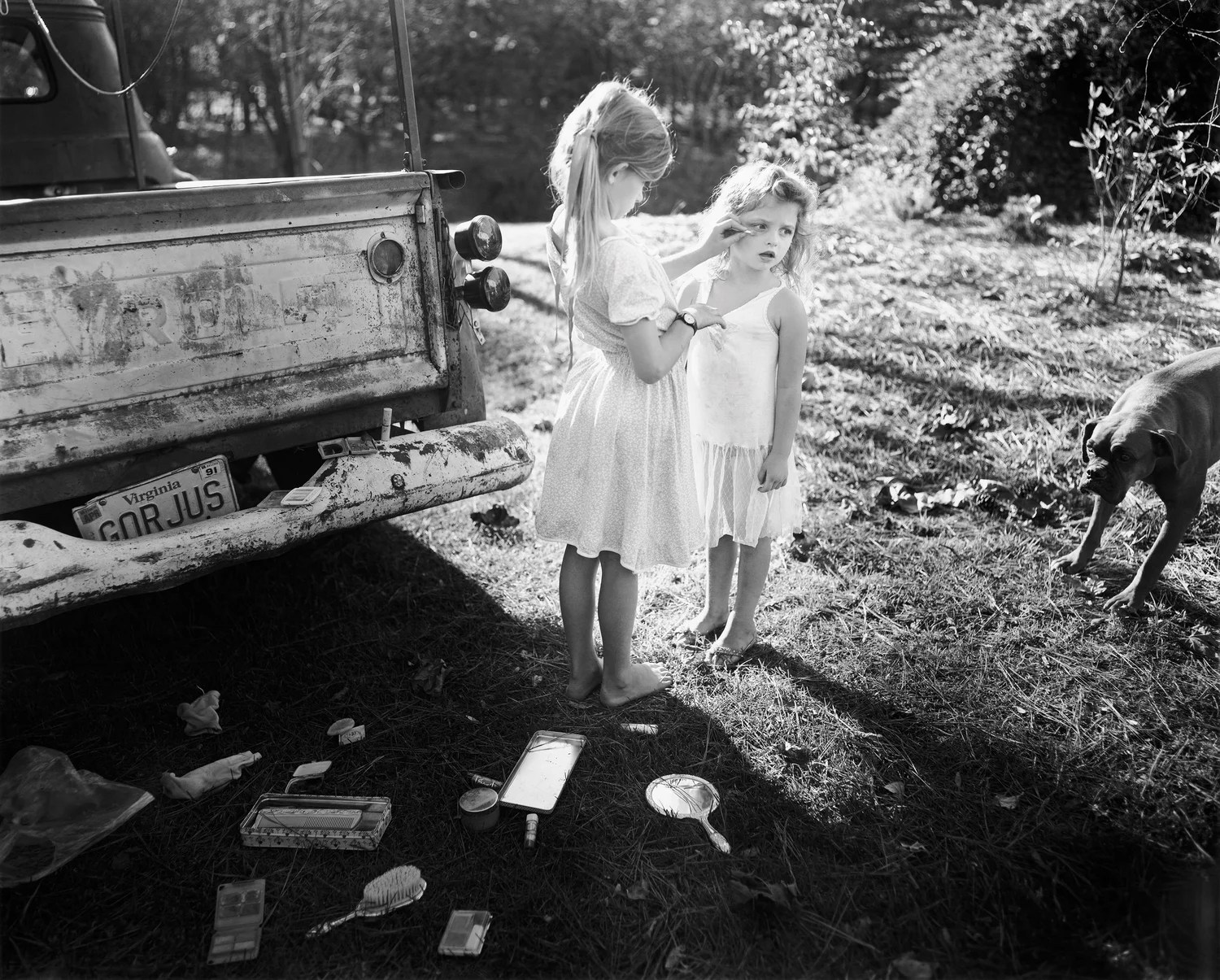
In her luminous, literary-leaning meditation on creativity Art Work, renowned photographer Sally Mann explores the never-ending battle between life and work. Self-described as a “kind of a how-to book, or a how-I-did-it book—a don’t-try-this-at-home book,” Art Work guides aspiring artists through distraction and doubt, rejection and self-censorship, discipline and routine. Mann is a funny, foul-mouthed sherpa, illuminating the at times treacherous path up creative peaks.
In the consoling chapter “Distraction,” she dispels the myth that the artist’s life is tedium-free:
“It’s hard for me to imagine Tolstoy cleaning out the chicken coop, and yet I know even he must have had those kinds of quotidian obligations and distractions. I’d be willing to bet his writing days were disrupted by just as many insistent demands on his time as my days are. He walked the dogs. He gambled. Like Levin, he scythed the wheat. He rode his dock-tailed horses through the birch forests of Yasnaya Polyana, his management-intensive four thousand acre property. I assume he had some interaction with his ten surviving children, and, given the evidence, also with his wife.”
In a characteristically forthright moment, Mann wonders whether the ordinary obligations of living might actually be compost for creativity:
“Is it possible that these myriad, time-gobbling intrusions—the crossed-out chores, the appointments, the forgotten fertilizer, the remembered wormer—might actually enrich or refresh the creative mind in some inexplicable and necessary way? It would be nice to think so, since there are so damn many of them.”
In a 1973 letter, Mann’s dear friend and fellow photographer Ted Orland, who also wrote a foundational manifesto on creativity Art & Fear, reveals a maddening truth: mundane matters tend to interrupt our most important work. As he observes,
“How do you work it into your schedule, I mean work in the important things, to keep the trivia from overrunning you like a creeping vine that slowly strangles you and saps all your energy in the process?
Unimportant things are obvious, that get done quickly (giving at least some transitory feeling of Accomplishment) but reappear again at the next mealtime or the next house-cleaning.
We Are Faced With Inopportune Surmountables…”
There’s a conception that artists live drastically different lives from mere mortals: Van Gogh had limitless hours to paint irises and night skies; Sylvia Plath didn’t have to worry about utility bills.
But artists—Mann argues—are also imprisoned by the chains of domestic chores and trivial work responsibilities.
They might compose Starry Night or revolutionize poetry but they still have to sweep the floors and go to the post office, make chicken soup and fold laundry on Sundays.
Certainly there are exceptions: if you were a privileged man in the 19th century who had a dutiful wife and a staff of servants, you might be free from the burdensome drudgery of day-to-day living but for the most part, artists are “just like us” (as the tabloids love to say). Van Gogh had to brush his teeth. Plath had to make breakfast for her family every morning.
As Mann writes with simple, surpassing beauty:
“The general perception of how creative people live is different, I think, from the reality. While I am convinced that I am uniquely beleaguered with the humdrum mundanity that seems to fill my days, I suspect that’s not true. I remember as a child being taken out to visit Pierre Daura, the Spanish artist who taught Cy Twombly to paint and who lived just a few miles up the road from our farm. He was sitting by the warm mineral springs that bubbled up into a slimy pool by his house, repairing a strap on his sandals with an awl and waxed thread, a sweating glass of iced tea beside him. No easel. No paint-smeared smock. No production deadlines, no guilt, no artistic angst anywhere.
It has taken me six decades since that summer morning to finally figure out that Daura was doing what artists actually do: They live their lives. Their everyday, boring, mundane, tedium-filled, sandal-repairing lives. Just like yours. Just like mine.”
No matter how carefully we safeguard our time against inconvenient intrusions, life “shows up” as they say in Alcoholics Anonymous. When Mann and her husband buy a tenderly loved, if outdated, trailer from an elderly woman named Peggy, they decide to rent it to a couple who enthusiastically responds to their ad (“This was exactly her dream house. She could tell from the pictures. She loved it.”)
Unfortunately, the seemingly normal couple who had been so grateful to find their “dream house” turns out to be a bunch of gun-totting (and, I assume, meth-addicted) nut jobs. Over the course of a few months, they refuse to pay rent and destroy Peggy’s sweet home among the sycamores.
When Mann returns to the property after finally evicting her tenants from hell, it’s in absolute squalor. The once pristine pink-and-rose decorated interior looks like an extreme episode of Hoarders. Peggy’s cherished belongings have been replaced by a disgusting disarray of empty bottles, chicken bones, pizza crusts, peanut butter jars, half-eaten plates of SpaghettiOs. There are rats and cockroaches everywhere.
The process of dealing with the trailer takes months, months, Mann angrily asserts, she could have been using to make art:
“For legal reasons, I have had to add up the hours I have spent dealing with the trailer since the day I discovered its…well, its violation. A big number. In fact, I spent more of four months on it, time I could have been taking, say, some pictures! Or making some prints. Or writing a book. Or walking my dogs. Or doing almost anything but calling the sheriff, banging on doors, hiring a lawyer, researching the toothless eviction laws, setting up my own motion-detecting cameras, meeting with the deputies who offered some cover while we ineffectually begged the Scarecrow, as I now called the emaciated man with the chin cleft, to open the door of the trailer for which he had not paid not one penny in rent for five months…”
There’s a humorous discrepancy between the fantasy of the artist’s life and its reality. Most imagine Mann’s life is glittering West Village art galleries and champagne-soaked book launch parties—not trashed trailers and toothless crack pots:
“Just the afternoon before, I had been informed that I had won the prestigious Prix Pictet award for photographs I had made in the Great Dismal Swamp. It was announced that night in London, champagne flutes had been raised to toast an artist the assembled crowd could not possibly imagine now man-hauling her muddy, scratched, terrified self up an escarpment to protect her husband from the possible wrath of a nutter with an arsenal, after having wasted two perfectly good months not making an iota of anything resembling art.”
The word artist conjures a too-cool hipster in a turtleneck and black beret, a face perpetually posed in a Bogartian look of nonchalance. A real artist resides in Greenwich Village or Montmartre—not in southern back swamps. Real artists are cigarette-smoking, absinthe-swilling bohemians. They can’t be bothered with bourgeois responsibilities like phone bills and mortgage payments.
But artists don’t just exist in some rarefied space. They, too, must deal with the banal demands of the everyday. Art doesn’t require a light-filled Brooklyn studio or a writer’s colony in a remote cabin in the Catskills. Art—Mann asserts—can be made anywhere: in subway cars, in line at the post office, on crumpled receipts and paper napkins, on your 30 minute lunch break. You can scribble a poem or sketch a drawing in small, stolen moments, no matter how hectic your days:
“Reading this, you are perfectly within your rights to complain that this isn’t what you thought the creative life was like, that you wanted to read about what real artists do, not what goes on in the boonies where you hardly know anyone who makes art. But people make art everywhere; they have made it in caves and on the sides of subway cars and hunched over a prison cot writing on toilet paper. They do it when they are exhausted, discouraged; they make their work in spite of not having the time or resources, never mind a computer or a studio. And they make it in the moments cobbled together from a day just as jam-packed as your day is, as you plug yourself into your soul-destroying day job or juggle a baby on your hip while packing the school lunches or while you recover from yet another catastrophic holiday, because they always are. Catastrophic.”
 In a heartening passage echoing Cheryl Strayed’s consoling idea that the “useless days will add up to something,” Mann comes to believe her trailer debacle played a formative role in her becoming.
Though we demand our every hour yield a harvest, squandered time is often the soil from which art springs:
“This whole trailer debacle joined the unhappy ranks of dead ends, lost causes, failures, disappointments, betrayals, and all-around time-wasters in my life. Viewed through the lens of the collective fantasy to which we seem unswervingly dedicated, the fabled “artist’s life” is Olympian in its lofty disdain for the ordinary and tedious. As susceptible to this fantasy as anyone else, my subversive brain says: Real artists don’t spend their time the way I just spent mine. Real artists make art and when they’re not making art, they are drinking absinthe with their friends and vacationing on St. Barts and even then they are probably provisioning their art larders.
…is there any art, any benefit at all, that could possibly emerge out of this trailer fiasco? At the time, I would have said hell no. What woman in her eighth decade needs to be swimming a fast river in December? But I see it differently now. There was value in those wasted four months. Not the least of it being that now I have an especially entertaining story…I love bringing good redneck stories to my often-amazed urban friends. But there is also an ineffable and complex accretion of human experience—and I am hardly the first to liken this to the calluses of a plowman’s hands—which is said to redound to the equally ineffable and slippery virtue of “character.” My children will happily recount to you the repellant tasks they performed with the assurance of character-building.
If it’s to be built by the hardships, by life’s slings and arrows, then by god I’ve got a ton of it, and my kids do, too. Beyond entertainment, there’s value in that. It gives you something to say in your art. It gives you the right to be saying it.”
Mann reminds us that art is made not in spite of life but because of it. The failures and fiascos are all fodder for the page (or the canvas).
Creativity is cyclical, not linear: we all go through fertile and fallow periods. When we’re not directly making art, we may assume nothing’s growing because we’re not seeing blossoms. But something subterranean is stirring beneath the surface. What looks like “doing nothing” is actually gestation:
“So despite time’s sands rushing the waist of my particular hourglass, I don’t feel like the four months away from my art practice were without value. And I’ll even posit that there is value in the time you just spent dicking around at whatever you just did, too (maybe even reading this), despite it appearing to have no redeeming artistic benefit. I’d go so far as to say that even when you stop working altogether, for long stretches, there is ultimate good in it for your creative work, whatever it is. Inactivity isn’t failure; like an athlete, your artistic muscles need time for recovery; repose is restorative. Paradoxically, not making art can teach you as much as making it, and if nothing else, it fills the reservoir of your desire.”


Be First to Comment